Furnished or Unfurnished? Compare First-Year Rental Costs
Compare three Dutch rental setups using first-year spending, move-in cash, furnishing inventories, and realistic plans for your belongings when you leave.
12 min read
Table of Contents
Table of Contents
Further Reading on Renting in the Netherlands
Newest Properties in the Netherlands
Explore the latest properties added to Luntero. Find new apartments, houses, and studios across the Netherlands — updated daily to help you discover your next home faster.
Why Luntero
One Workspace for Your Dutch Rental Search
Luntero combines apartments, rooms, studios and houses from rental websites with homes published directly on Luntero. Filter by your needs, compare your options and confirm availability, price and conditions with the advertiser.
Listings From Many Dutch Sources
Browse listings from Funda, Pararius, Kamernet and other supported websites alongside rentals published directly on Luntero. Coverage is broad, but does not include every home on the market.
Intuitive User-Friendly Interface
Navigate our clean and straightforward design effortlessly on both desktop and mobile devices for a seamless apartment, house, or room hunting experience in the Netherlands.
Multilingual Support for Expats & Locals
Browse rental listings in English, Dutch, Spanish, French, German, and more. Luntero ensures you can find your next home in the Netherlands in the language you're most comfortable with.
Regular Listing Refreshes
Luntero refreshes collected listings regularly and search alerts email new matches after a successful check. A source can change between refreshes, so verify decisive details there.
Understand Dutch rental terms before you sign the lease.
Renting in the Netherlands comes with unique rules, legal phrases, and housing abbreviations that can be tricky. The Luntero Rental Glossary is your guide to every rental term — from tenancy agreements, deposits, and agency fees to utility charges, rent control, and tenant rights. Whether you’re new to renting, moving as an expat, or just want to avoid hidden costs, our glossary helps you rent smarter, negotiate better, and protect yourself from mistakes.
A furnished rental can reduce the number of things you must buy before your first night. An unfurnished home can let you use furniture you already own. Neither fact establishes which offer costs less over your first year. The answer depends on the actual inventory, the amounts charged, how long you can and intend to stay, and what happens to your belongings afterward.
Compare two numbers before choosing: the money you need available around move-in, and the cost you expect to incur over your planned stay. A refundable deposit affects the first number without automatically becoming an expense in the second. Buying a sofa affects both, but a possible resale is uncertain. Keeping those differences visible makes the comparison more honest than assuming furnished always means expensive or unfurnished always means good value.
Start with the inventory behind the label
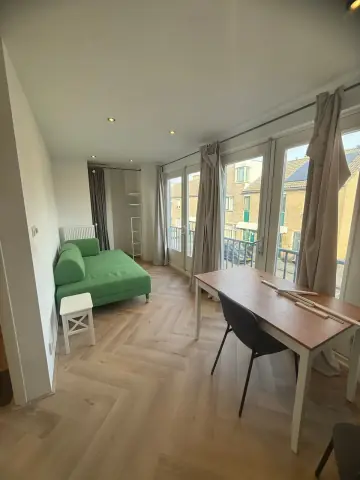
Dutch advertisements use terms such as kaal, gestoffeerd, and gemeubileerd. If you need orientation, Luntero's guide to rental furnishing terms introduces the broad categories. For a financial decision, move from the category to an itemized list for the particular home. Do not assume that a label guarantees curtains, kitchenware, a washing machine, or a desk suitable for working at home.
Ask what belongs to the landlord, what belongs to the departing tenant, and what is merely present in the photographs. A floor offered for takeover is different from a floor included in the rental. An appliance can be physically present while its ownership and replacement arrangements remain unanswered. Record those questions before assigning a cost of zero.
Use a room-by-room inventory. In the bedroom, check the bed frame, mattress, wardrobe and window coverings. In the living room, consider seating, a table, lighting and your work arrangement. In the kitchen, separate installed appliances from loose equipment. For each missing essential, decide whether you own it, can borrow it, need to buy it, or can manage without it. That exercise defines the basket you are comparing.
Item or arrangement
What to confirm
Why it changes the calculation
Floor and window coverings
Included, tenant-owned, or proposed takeover
Purchase and removal can be separate costs
Bed and mattress
Exact items, condition and dimensions
An included bed may not meet your needs
Desk and chair
Included inventory and practical fit
Remote work can require additional purchases
Washing machine
Ownership, connection and maintenance arrangement
You may need delivery or another laundry solution
Loose kitchen equipment
Actual list rather than staged photographs
Small purchases accumulate during arrival
Storage
Your allocated space and access
Keeping duplicate furniture may require paid storage
A complete basket is more important than a long one. Someone moving with a bed and table needs a different budget from an international arrival carrying two suitcases. Use your household's essentials instead of importing another renter's shopping list.
Separate recurring charges, purchases, and money held temporarily
Create three groups. The first contains recurring payments: basic rent, documented furnishing-related charges, services, and household bills. The second contains one-off spending: purchases, delivery, assembly, moving, and any agreed removal work. The third contains cash temporarily unavailable, such as a refundable rental deposit. Add payment dates to every group.
The government's tenant plan states that the maximum deposit for tenancy agreements dated from 1 July 2023 is two months of basic rent. Check the applicable agreement and current rules rather than calculating the deposit from an inclusive marketing total. A deposit is not guaranteed spending, but you need enough money to pay it and cannot assume it will fund your next move immediately.
Avoid describing every difference between two homes as a furniture premium. The furnished property might also have a larger floor area, another location, or a different energy arrangement. First compare the whole offers. Only isolate a furnishing-related difference when the contract supplies that distinction or when you are explicitly using a simplified hypothetical example.
Start with a cost worksheet for your own stay
For each offer, write the number of months you must pay, the complete recurring amount and the one-off spending needed to obtain the same usable inventory. Multiply the recurring amount by those months, then add purchases, delivery, assembly, moving and any agreed fit-out or removal spending. If a furnishing payment is already included in the recurring total, do not add it again.
Keep a refundable deposit in the separate cash calendar. Put possible resale proceeds in a separate scenario rather than subtracting them from money you need today. If a required price or item is unknown, leave the calculation incomplete and ask for it. This worksheet compares spending on defined offers; it does not determine whether a charge is lawful or whether a contract permits your intended departure.
Work through a first-year example with the same baseline
The following figures are invented to demonstrate arithmetic. They are not Dutch market averages, retail quotations, recommended charges, or estimates for any particular city. Assume that three otherwise comparable offers have the same basic rent of €1,200 per month and the same other housing costs of €250 per month. Assume a lawful arrangement and an itemized contract; legal classification still requires the actual documents.
Offer A provides the household's required furniture for a separately identified €150 monthly amount. The household buys €200 of personal extras and spends €100 on moving those belongings. Offer B includes the floor and window coverings but requires €2,000 of furniture purchases, €300 delivery and assembly, and €200 moving expenditure. Offer C requires an additional €1,200 of agreed fit-out expenditure beyond B. For simplicity, no financing cost or inflation is modeled.
First-year spending assumption
A: supplied furniture
B: own furniture
C: own furniture plus fit-out
Basic rent: 12 × €1,200
€14,400
€14,400
€14,400
Other costs: 12 × €250
€3,000
€3,000
€3,000
Identified furnishing amount
€1,800
€0
€0
Furniture and personal extras
€200
€2,000
€2,000
Additional fit-out
€0
€0
€1,200
Delivery and assembly
€0
€300
€300
Moving belongings
€100
€200
€200
Total before deposit or resale
€19,500
€19,900
€21,100
A has the lowest first-year spending under these assumptions. That result follows from the invented inputs, not from the furnishing labels. If B's purchases cost €1,200 instead of €2,000, B's total becomes €19,100 and the ordering changes. If A lacks a necessary workstation, add its purchase and delivery before comparing again.
You also still own B's furniture at the end of the year. That has practical value if you can use it in the next home, but ownership does not guarantee a particular resale price. Show the spending total first. Then add a separate scenario for reuse or sale, with its assumptions visible.
Calculate move-in cash independently
Suppose all three invented offers require a €2,400 deposit, the first month's basic rent, and the first month's €250 other costs before or around handover. Suppose A's first €150 furnishing amount and all one-off expenditure are also payable then. Timing varies in real offers; these are scenario assumptions, not payment rules.
A requires €2,400 + €1,200 + €250 + €150 + €200 + €100 = €4,300 around move-in. B requires €2,400 + €1,200 + €250 + €2,000 + €300 + €200 = €6,350. C requires B's €6,350 plus €1,200 fit-out, or €7,550. These totals explain why A might be feasible for someone whose available cash cannot support B, even if B becomes cheaper over a longer stay.
Now test dates rather than treating “around move-in” as one moment. Your old deposit might remain unavailable after you pay the new one. A delivery company may need payment before your salary arrives. Buying items over several months reduces immediate expenditure only if you can comfortably live without them until then. A staged shopping plan should identify the essentials for sleeping, preparing food and working from the first week.
Do not use a presumed deposit refund to balance a budget that otherwise fails. Keep a reserve for delay or a disputed deduction. That reserve is a household choice based on risk and circumstances; there is no universal amount that makes every move affordable.
Check how supplied furniture is charged
An advertised furnished home does not make every requested amount self-explanatory. Ask which items the payment covers, whether it is included in another amount, and what documentation supports it. The Huurcommissie distinguishes movable items and integral parts of the dwelling when assessing service costs. A loose appliance and an installation forming part of the property can receive different treatment. Do not decide the legal category solely from the English word “furniture.”
The practical question is narrower: can you identify what you receive and how the contract charges for it? Request the inventory and calculation. If an amount seems inconsistent with the documents, seek clarification or advice through the relevant official route. Do not assume a monthly amount is valid merely because it appears in an advertisement, and do not assume an unexplained amount can simply be deducted from the rent yourself.
There is an announced change relevant to agreements signed around the coming year. As checked on 25 November 2026, the Huurcommissie describes service-cost rules for contracts signed from 1 January 2027, including changes to charges for movable items. If your signature date will fall in that period, check the applicable current guidance. A future start date and a signature date are different facts; get advice if the distinction affects your agreement.
Test the stay length without inventing flexibility
For a simplified furnishing-only comparison, let supplied furniture cost €150 monthly. Let owning the required items cost €2,500 in total, including purchase, delivery and moving. Ignore resale, extra maintenance, finance and differences in the property. Supplied furniture reaches €2,500 after 16⅔ months: €2,500 divided by €150. That is a mathematical crossing point for this simplified example, not a recommendation to sign either contract.
At six months the recurring amount is €900; at twelve it is €1,800; at twenty-four it is €3,600. The ownership basket remains €2,500 only if there are no additional costs. A second move, storage or replacement can change it. Conversely, furniture you already own may reduce new expenditure substantially. Compare the relevant basket rather than charging yourself again for its original purchase price.
Most importantly, a six-month scenario does not establish that you may leave a real agreement after six months. Furnishing status does not determine the legal contract type, minimum commitment or termination rights. Read the actual agreement and verify unclear obligations before attaching a stay length to the calculation. Flexibility you do not possess has no budgeting value.
Include the exit plan while you still have time
An ownership budget needs an exit plan. Will the next home accept the furniture? Can it pass through the next staircase? Would transporting it cost more than replacing it? These questions are especially important for a household expecting another international move. A cheap purchase can become inconvenient if it requires storage and repeated delivery.
Consider three endings separately. In a reuse scenario, you pay to move the items and obtain continuing use. In a sale scenario, you incur selling effort and uncertain proceeds. In a disposal scenario, you need an appropriate removal route and potentially a charge. Do not combine the highest plausible resale with the lowest plausible moving cost and present the result as certain.
For example, B's first-year spending above was €19,900. If the household later receives an explicitly hypothetical €600 from sales and pays €150 to remove the remaining items, its net spending becomes €19,450. If nothing sells and removal costs €300, the result becomes €20,200. Both are scenarios. Neither replaces the cash required when purchases were made.
For supplied furniture, ask what must be present and in what documented condition at handover. Keep records of existing marks or missing pieces. The government's contract guidance recommends recording the property's condition in writing at the beginning. Apply that evidence habit to the agreed inventory without promising that photographs resolve every later disagreement.
Choose the option that fits your actual constraints
A new arrival with limited cash may prefer a sufficiently equipped home even when a longer ownership scenario appears cheaper. The benefit is avoiding a large initial outlay and coordinating fewer deliveries during arrival. That benefit disappears if essential furniture is missing or the recurring payments leave too little room for other necessities.
A household already owning well-fitting furniture may reach a different conclusion. Its relevant expenditure is transport, any gaps, and potential storage, not the cost of buying an entire home again. Measure larger items against the property and its entrance route before deciding that existing possessions automatically solve the setup problem.
A renter with an uncertain relocation date needs to examine commitments carefully. Furniture rental, storage or temporary purchases can create their own cancellation conditions and extra payments. The right comparison includes those agreements alongside the housing contract. An attractive monthly number does not answer what you owe if plans change.
At this point, use Luntero's comparison page to keep candidate property differences visible, with your inventory and cash-flow sheet alongside it. The comparison tool supports the shortlist; your written offer, inventory and household budget supply the decisive financial inputs.
Ask for the missing facts before choosing
Send a focused message naming the home and your questions: “Could you confirm which furniture and appliances remain, which items are owned by the departing tenant, and the separate amounts for basic rent, services and supplied furnishings? Please also confirm any agreed takeover payment and the inventory that will form part of the handover.” Replace each question with the issue actually missing from that offer.
Then compare complete offers once more. Keep uncertain amounts labeled, show both first-year spending and move-in cash, and state your assumed stay. If an essential answer remains absent, record that as a decision risk rather than quietly entering zero. You can return to the rental search with clearer requirements: the furnishing category, your usable cash, the necessary inventory and the recurring total you can sustain.
The best first-year choice is the one whose costs and commitments you understand and can afford. A label helps you find candidates. An inventory, a cash calendar and a transparent calculation help you choose between them.
Understand Dutch rental terms before you sign the lease.
Renting in the Netherlands comes with unique rules, legal phrases, and housing abbreviations that can be tricky. The Luntero Rental Glossary is your guide to every rental term — from tenancy agreements, deposits, and agency fees to utility charges, rent control, and tenant rights. Whether you’re new to renting, moving as an expat, or just want to avoid hidden costs, our glossary helps you rent smarter, negotiate better, and protect yourself from mistakes.